A listener wrote in with a great question about why their back gets sore walking at a slow pace, but not when walking briskly. I brough in movement specialist, Margy Verba to answer this question.
Have you ever experienced lower back soreness when you walk slowly? What’s the deal with that?
Chances are you’ve noticed this phenomenon, too, and if you’ve ever wondered WHY walking slowly feels so different to walking quickly you’re in luck, because that’s the topic of today’s episode.
I got a great question from a listener who wrote this:
“Hello Monika, I have a quick question if you have time to answer. Something i can’t figure out. When i do my normal brisk walk (eg. walking to work) everything feels good, but when i do a slow saunter (eg. strolling in the park with my girlfriend) my lower lumber starts to ache. I appreciate it might be difficult to know without a visual, but do you have any insight on how the mechanics of a slow stroll might be impacting my lower back?”
I have my own thoughts and opinions, but I immediately thought, “this is a perfect question for Margy”.
So I coerced my good friend and Anatomy in Motion colleague Margy Verba to come on the show to help me answer this question.
Margy is a fellow Anatomy in Motion instructor, and she also teaches her own movement workshops for non-movement professionals. Her attention to detail and ever-questioning mind makes her an incredible movement educator.
Whenever I have a biomechanics question, Margy’s the first person I think of to ask because she’s constantly learning about and exploring movement and anatomy in her own body.
So if you’ve ever wondered why walking at different speeds can have such a different impact on your lower back, and other joints, I think you’ll really love this discussion.
PS Margy and I will be doing a regular Q&A segment, so if you’d like to submit your own question for us to answer on Movement Detectivery, please shoot me an email: monika@monikavolkmar.com
Topics in this episode include:
- The “reverse pendulum” (an movement experience you can try)
- The often overlooked role of momentum in gait
- What to check if walking slower feels less comfortable for your back
- What your body needs to do within a single footstep for efficient gait
- The value of walking slowly
- Possible psychological considerations for slow vs fast walking
And if you’d like to learn more about what we mean by “what your body needs to do within a single footstep”, please check out my online program Liberated Body.
And stay tuned for a special reverse pendulum video from Margy, which she has promised 😉
Where to find Margy online:
Instagram: @flowmotioneducation
Youtube: FlowMotion Education – YouTube
Website: www.flowmotioneducation.com
Here’s a little more about Margy Verba:
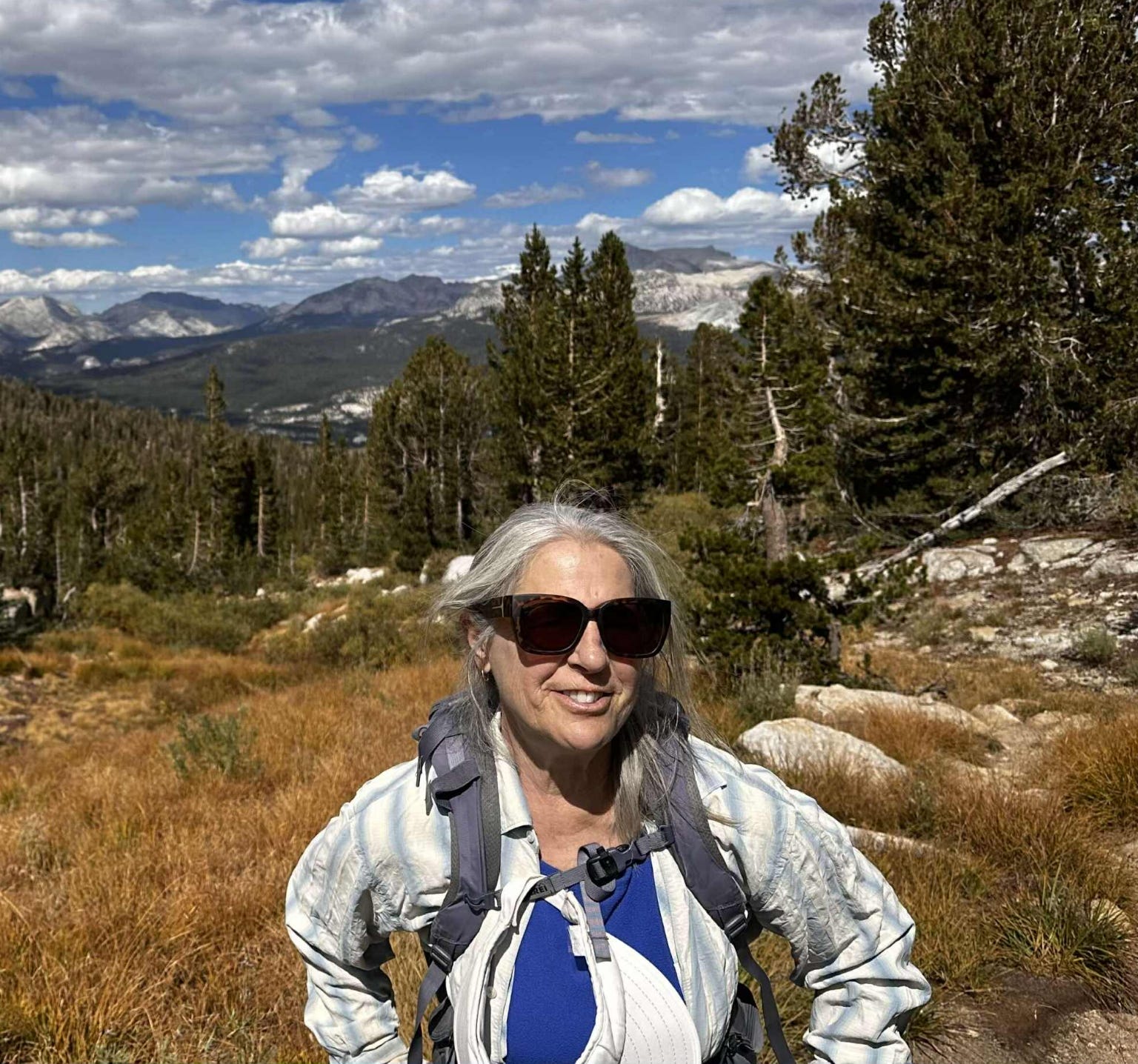
I am fascinated by movement and the body’s capacity to heal. Always a mover, I grew up studying dance, playing sports, and backpacking as much as possible. While in college, in the mid-1970s, I started teaching dance and fitness classes (remember leg warmers and shiny leotards?). In the early 1990s, I discovered Pilates, and went on to complete internationally acclaimed Madeline Black’s teacher training. Madeline first introduced me to therapeutically oriented Pilates, and I have never looked back. Continuing my education in a therapeutic orientation, I have a diverse range of training with world renowned instructors/researchers (see education below).
In 2005 I was hired by the U.S. Men’s and Women’s U.S. Ski Teams to develop a custom Pilates program. Today my clients are primarily people in chronic pain and athletes who are stymied by injuries. I offer both private appointments, as well as a series of self-care courses for pain alleviation and prevention. The focus of my practice is knowledge and awareness, achieved through biomechanics education and movement exploration. This focus empowers my clients to practice self-care and be informed consumers of healthcare. In short, I enable my clients to take ownership of and actively participate in, their own healing process.
The primary influence on my practice is Anatomy in Motion (read more about AiM here). I have studied extensively with AiM founder Gary Ward, author of “What the Foot”, and as of 2021 I am an official AiM Instructor. AiM is based on the premise that gait (AKA walking) uses every joint in the body in all three dimensions. By analyzing gait and its component motions, we can address non-optimal movement at both a global (full body) and focal (individual joints) level. I have also been focusing my studies on pelvic floor and breathing dysfunctions (hint: they are not unrelated!). My clients get individualized corrective exercise programs, which provide lasting results, rather than simply providing symptomatic relief.